


01What Is Skaform and What Is Inside the Panel?
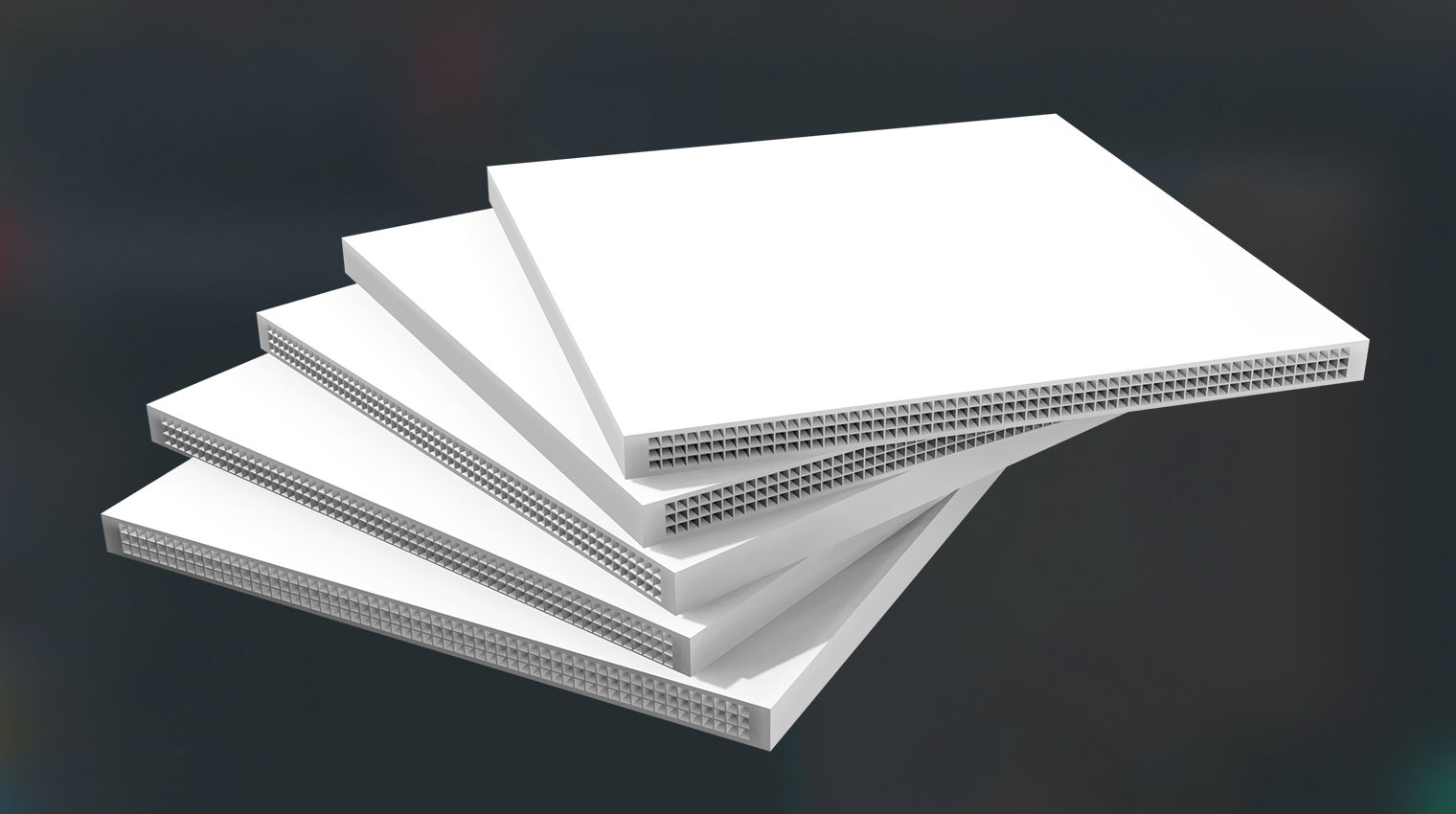
A polymer formwork panel forms the surface in contact with the concrete in reinforced concrete formwork with a plastic-based panel instead of plywood. The Skaform panel, for which we are a dealer, is made of polypropylene and is not solid but hollow-core: between the two flat faces of the panel there are thin-walled channels running along the panel.
The logic of the channelled structure has to do with where a panel is stressed when it bends. When the panel bends under load between two supports, most of the stress is carried by the top and bottom faces; the middle of the panel works less. In Skaform, instead of being filled with material, this middle part is divided into thin walls that connect the two faces. This gives a lighter panel for the same thickness.
The scale of this can be worked out from two values in the ITU test report. The 18 mm panel weighs 10.3 kg per square metre, while the density of the panel material was measured as 1182 kg/m³. A solid 18 mm panel of the same material would weigh about 21.3 kg per square metre. In other words, about half of the volume of the panel is void (this ratio is not stated in the report; it is our own calculation from the two measurements).
A full 1250 × 2500 mm panel is 3.125 m². With the measured unit weights, one panel weighs about 30 kg at 15 mm, about 32 kg at 18 mm and about 41 kg at 21 mm. This is the weight the formwork carpenter feels when carrying the panel into place. We offer the panel in 12, 15, 18 and 21 mm thicknesses.
02Tests Carried Out at the ITU Faculty of Civil Engineering
The physical and mechanical properties of Skaform panels were determined by testing at the Faculty of Civil Engineering of Istanbul Technical University (ITU), at our request. The report was prepared by Prof. Dr. Özkan Şengül within the scope of the ITU Revolving Fund and is dated August 2023. The following tests were carried out on specimens cut from panels 15, 18 and 21 mm thick:
- Unit weight and density: The weight per square metre of the panel and the density of the panel material.
- Tensile test: Modulus of elasticity, yield strength and tensile strength at 15 °C and 40 °C, on specimens cut parallel and perpendicular to the channels.
- Bending test: As stated in the report, to ASTM D790-17, at 15 °C and 40 °C, flexural modulus and flexural strength in two directions.
- Impact test: Charpy impact test with unnotched specimens at 25 °C, in two directions: in the plane of the panel and perpendicular to it.
| Nominal thickness | Unit weight | Material density | Void ratio (calculated) |
|---|---|---|---|
| 15 mm | 9.5 kg/m² | 1180 kg/m³ | about 46% |
| 18 mm | 10.3 kg/m² | 1182 kg/m³ | about 52% |
| 21 mm | 13.2 kg/m² | 1210 kg/m³ | about 48% |
Each mechanical test was carried out with five specimens. Alongside the mean, the report also gives a characteristic value: it is found by subtracting 1.476 times the standard deviation from the mean. This factor comes from the t-distribution for a 90% confidence level in a test with five specimens. It is this characteristic value, not the mean, that is to be used in calculation; the strength and stiffness values on this page are also characteristic values.
The measured density also tells us something. The density of pure polypropylene is in the range of about 0.90-0.93 g/cm³; the 1.18-1.21 g/cm³ measured for the Skaform panel material is noticeably higher. The manufacturer states that the main material of the panel is polypropylene (PP); this difference in measured density shows that the material contains additives heavier than polypropylene.
Get a quote for your project
Tell us about your facade or shoring requirement; our technical team will get back to you with an erection plan and a quotation.