


01Why is wind the first thing to look at on a facade scaffold?
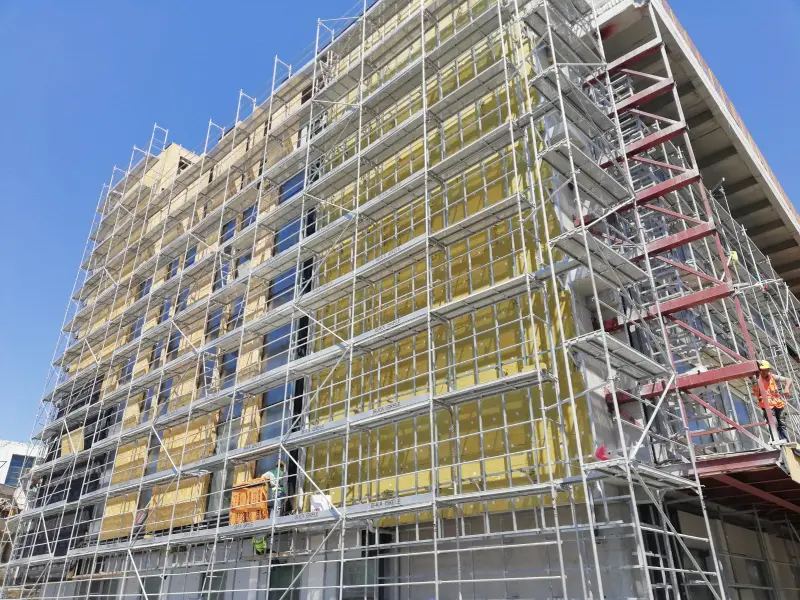
A facade scaffold is a light, slender and tall structure: its self-weight is small, while the surface exposed to wind is large. That is why what keeps a scaffold standing is often not so much the capacity of the standards as having the ties and diagonal braces in the right place and in the right number.
A team from Lublin University of Technology in Poland measured wind on 120 facade scaffolds erected across the country between April 2016 and November 2018. The scaffolds were 6 m to 58 m high, with facade areas from 70 m² to 1,560 m². Calculations using the measured wind showed that wind affects the ties most, while the highest stresses occur in the standards and base jacks of the bottom frames.
A doctoral study in Japan on door-type frame scaffolds looks at the subject from another angle: according to the accident reviews cited in the thesis, about 10% of serious scaffold collapses are caused by wind. Field measurements cited in the same thesis show that in strong wind the load concentrates on a few ties, particularly in the upper part of the scaffold, and that the design value is exceeded at some ties.
The same Polish measurements also shed light on vibration: the first natural frequency of scaffolds without additional load was between 0.7 Hz and 4 Hz, and this value depended not only on the size of the scaffold but also on the quality of the ties. A worker walking on the platform excites at 1-2 Hz, wind at up to 2 Hz and a drill at around 7-8 Hz. In other words, some of the actions that shake a scaffold fall within its own frequency range.
02Which parts of the scaffold does wind load most?
The measurements agree: the middle of the facade is relatively calm, while the corners and side edges of the scaffold receive more wind than the calculation assumes.
In an experimental study published in 2025, measurements were taken on 10 facade scaffolds in front of buildings with solid facades, using five anemometers each on the second-to-last lift. The local wind speed at the scaffold surface varied between 20% and 140% of the reference speed above the roof. In the middle of the facade, the location factor in the standard covered most measurements; at corners and edges, however, the standard value was exceeded by up to 20% in normal weather and by more than 100% in storms. The 2-second gust reached 1.5 to 2.5 times the 10-minute mean speed.
The authors therefore do not consider a single factor for the whole scaffold sufficient; they propose higher factors at corners and edges and lower ones in the middle of the facade. Wind tunnel tests in Japan also show that the largest tie force usually occurs at the side edge of the scaffold, especially at corners, and when the wind blows almost parallel to the scaffold.
Standards treat this load in two situations. In the calculation based on TS EN 12811-1, wind is applied separately perpendicular and parallel to the facade; when the scaffold is in service, working wind is added to self-weight and service load, and when it is out of service, the maximum wind is applied, together with 50% of the service load for load classes 4, 5 and 6. The point stressed by the Polish team is this: the wind approach in the scaffold standard was written for the design of a new system and does not account for the terrain, neighbouring buildings and facade solidity at a particular site. Of the three scaffolds analysed in detail, for the one in front of the building with a solid facade, the stresses in the standards and base jacks exceeded the resistance limit under wind applied parallel to the facade according to the scaffold standard; the calculation with the measured wind also gave higher values for this scaffold than the general wind standard (Eurocode). For the scaffold on the facade with large openings, the standard calculations remained on the safe side.
03How do missing or weak ties affect a scaffold?
A scaffold with missing ties is not only loaded more heavily in wind, it also sways more easily. And the force a tie can carry is only as much as the wall it is fixed to can take.
In a site-verified model of a frame facade scaffold 24.15 m high and 25.73 m long with 36 ties in total, removing only the 6 ties in the upper right corner reduced the first natural frequency of the scaffold from 2.36 Hz to 1.23 Hz, roughly by half. When 10 ties evenly distributed over the facade were removed instead, the drop was much smaller (2.30 Hz). The lesson is clear: leaving a large area untied is as dangerous as reducing the number of ties. The same study shows that diagonal braces prevent sway along the facade and ties prevent sway perpendicular to it; one does not replace the other.
The other end of the tie is the wall. In tests by the National Institute of Occupational Safety and Health, Japan, four different anchors fixed in autoclaved aerated concrete (ALC) panels showed a pull-out resistance of about 5 kN even in the best case, whereas the resistance required of the tie component in Japan is 8.82 kN. The researchers recommend that on such walls the number of ties be determined by the resistance of the anchor, not by that of the tie component.
In Turkey, Annex 5 of the Turkish Regulation on Health and Safety in Construction Work requires ties to be installed according to the manufacturer's instructions and the lowest tie to be no more than 4 m above the base plate. The tie pattern, the tie components and how they are to be fixed to the structure must also be included in the erection, use and dismantling plan.
04How much do netting and sheeting increase the wind load?
Sheeting turns a tube lattice that wind passes through into a sail that catches the wind. That is why work on a sheeted scaffold must not continue without increasing the number of ties.
In wind tunnel tests at Tokyo Polytechnic University on scaffolds with nonporous cladding (fully sheeted), the largest mean panel force coefficient was 1.7; the value in the European and Chinese rules cited in the thesis is 1.3. As the scaffold area per tie increased, the peak force on the tie also rose rapidly. The author recommends that on scaffolds with nonporous or very densely woven sheeting the ties be placed continuously in vertical lines.
In the Polish field measurements, on scaffolds fitted with protective netting, the low coefficient given in the standard for netted scaffolds was exceeded in more than half of the measurements. The regulation is clear on this point: if the scaffold is covered with netting, sheeting, boards or similar cladding, the number of ties between the structure and the scaffold is increased according to the manufacturer's instructions, taking the wind load into account.
05Apart from wind, what weakens a scaffold?
Wind and ties are one half of the story. The other half is decided by the load on the platform, the ground the scaffold stands on and the condition of the components.
- Load: Every scaffold is designed to a load class. The six classes in TS EN 12811-1 define uniformly distributed loads from 0.75 kN to 6.00 kN per square metre. The regulation requires a sign showing the maximum load the scaffold can carry to be displayed in a visible place.
- Ground: Researchers working on a verified facade scaffold model point out that uneven settlement of the ground can decisively change the distribution of forces. In the Polish measurements, too, the places most stressed by wind were the standards and base jacks in the lower lifts.
- Damaged component: In laboratory tests in Lublin, in a frame with a standard bent by about 1 cm over a 2 m member, the stress in the standard rose to about twice that of an undamaged frame; a local dent such as a hammer blow reduced the compressive capacity by about 10%.
Each of these three subjects is covered in the detailed articles we publish separately under the facade scaffolding topic: number of ties and anchor selection, wind load on sheeted scaffolds, load class and maximum load sign, base jacks and foundations, and sorting out damaged components.
06How are these findings addressed on site and in our products?
The common message of the research is that how a scaffold is erected matters more than how it is calculated. That is why we write the tie pattern, the sheeting condition and the ground into the plan before erection.
- For Safescaff and Ringscaff, our technical team prepares the erection plan, section drawing and tie pattern for every job. Standard plans and tie patterns exist for heights up to 24.00 m; for higher scaffolds we carry out a project-specific structural calculation.
- The A/B designation in the code on the TSE certificate of both systems shows that the scaffold has been calculated for use without cladding (A) and with netting or sheeting (B). Knowing from the start whether sheeting will be fitted allows us to set out the tie pattern accordingly.
- During erection, ties are fitted according to the plan as the scaffold rises; there is no waiting for the scaffold to be completed. During dismantling, a tie is not removed before the scaffold above it has been dismantled.
- At the edges of structural works where materials and people need to be caught, we use Safenet safety net fans in addition to the scaffold.
07Frequently asked questions
Which component of a facade scaffold does wind load most?
According to calculations based on measurements on 120 facade scaffolds in Poland, wind affects the ties most; the highest stresses occur in the standards and base jacks of the lower lifts. Corners and edges receive more wind than the middle of the facade.
How does reducing the number of ties affect the scaffold?
In a verified scaffold model, removing 6 ties at a corner reduced the first natural frequency of the scaffold by about half; the scaffold became much easier to sway. When the same number of ties was removed evenly across the facade, the effect remained very small. Leaving a large area untied is the worst option.
What should I do if I fit netting or sheeting to the scaffold?
The regulation requires the number of ties on a sheeted scaffold to be increased according to the manufacturer's instructions, taking the wind load into account. Wind tunnel tests show that the force coefficient on a fully sheeted scaffold can reach 1.7; the tie pattern should be reviewed before sheeting is fitted.
At what height should the lowest tie be?
According to Annex 5 of the Turkish Regulation on Health and Safety in Construction Work, the ties at the lowest level must be no more than 4 m above the base plate.
-Sources
- Lipecki T., Jamińska-Gadomska P., Bęc J., Błazik-Borowa E., "Façade scaffolding behaviour under wind action", Archives of Civil and Mechanical Engineering, 20:27, 2020.
- Jamińska-Gadomska P., Sumorek A., "Experimental Investigation of Local Wind Effects on Façade Scaffolding Structures", Applied Sciences, 15(22), 12196, 2025.
- Bęc J., "Influence of anchoring and bracing system on dynamic characteristics of façade scaffolding", Archives of Civil Engineering, 69(4), 493-506, 2023.
- Bęc J., Błazik-Borowa E., Szer J., "Analysis of scaffolding harmonic excitation", Bulletin of the Polish Academy of Sciences: Technical Sciences, 71(1), e144577, 2023.
- Wang F., "Aerodynamic Characteristics of Scaffolding with Nonporous Cladding", doctoral thesis, Tokyo Polytechnic University, Graduate School of Engineering, 2013.
- Takanashi S., Ohdo K., Takahashi H., "Strength of Scaffolding Tie-Bar Anchors Fixed to ALC Panels" (in Japanese), Journal of Occupational Safety and Health (労働安全衛生研究), 2(2), 85-90, 2009.
- Jamińska-Gadomska P., Bęc J., Lipecki T., Robak A., "Verification of the façade scaffolding computer model", Archives of Civil Engineering, 64(1), 41-53, 2018.
- Robak A., "Badania uszkodzonych elementów ram rusztowań systemu fasadowego" (Tests of damaged frame components of facade scaffolding, in Polish), Budownictwo i Architektura, 12(2), 267-274, 2013.
- Yaşar M., Yazıcıoğlu S., "Ön yapımlı bileşenlerden oluşan dış cephe iskeleleri, iskelelere etkiyen yükler ve iskele deneyleri" (Facade scaffolds made of prefabricated components, loads on scaffolds and scaffold tests, in Turkish), International Scientific and Vocational Journal (ISVOS Journal), 2(2), 1-11, 2018.
- Yapı İşlerinde İş Sağlığı ve Güvenliği Yönetmeliği (Turkish Regulation on Health and Safety in Construction Work), Annex 5 "Yapı İşlerinde Kullanılan İş Ekipmanlarının Asgari Sağlık ve Güvenlik Şartları" (Minimum health and safety requirements for work equipment used in construction work) (Official Gazette 31.12.2018, No. 30642, 4th duplicate issue).
Related systems
 View →Safescaff H Frame Facade ScaffoldingStacking H frame facade scaffolding, load class 4, hot-dip galvanized...
 View →Ringscaff Ringlock ScaffoldingEN 12810 / 12811 compliant, load class 4, hot-dip galvanized ringlock scaffolding system...
 View →Safenet Safety Net FanEN 1263 compliant safety net fan with steel brackets, 4 m outreach from the facade, installed by crane...
Get a quote for your project
Tell us about your facade or shoring requirement; our technical team will get back to you with an erection plan and a quotation.