


01What Is Ringscaff?
Ringscaff is a modular ringlock (rosette-type) scaffolding system that we manufacture in our own factory.
Ring-shaped rosettes welded to the vertical standards at 50 cm intervals allow ledgers and braces to be fixed without any clamps - with just a wedge and a hammer blow. Thanks to this connection principle, Ringscaff can be erected with the same set of components both as facade working scaffolding and as shoring under slabs - unlike most systems on the market, a single inventory covers two different functions.
02Engineering Principle and Origin of the System
The rosette connection principle is regarded as a turning point in modern scaffolding. Introduced to the industry in the mid-1970s, it brought the idea of fixing up to 8 members at a single point through a multi-hole connection ring (rosette) welded onto the standard, and has since become the basic engineering principle of modular scaffolding systems.
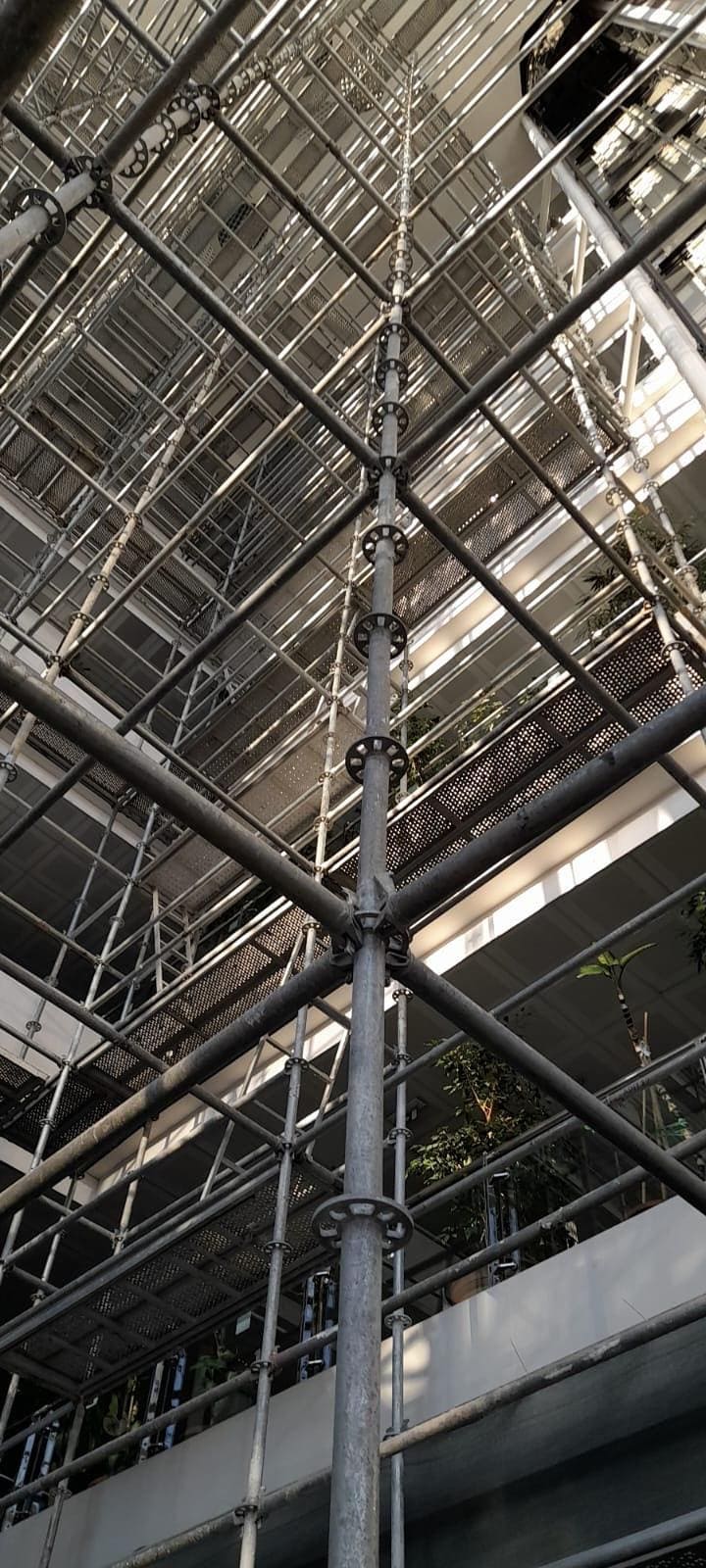
Ringscaff uses the same basic engineering principle: the rosettes on the standards lock the wedge heads of ledgers and braces, creating a multidirectional, rigid connection at a single node. As a result the system adapts to flat facades as well as to circular, stepped and angled surfaces - because a connection point repeats every 50 cm, the geometry can be shaped almost freely.
03Technical Data and Standards
Ringscaff is designed in full compliance with European and Turkish standards (EN 12810-1/2, EN 12811-1/2, adopted in Türkiye as TS EN):
| Property | Value |
|---|---|
| Load class | Class 4 (EN 12811-1) |
| Uniformly distributed load | 3.00 kN/m² (~305 kg/m²) |
| Concentrated (partial area) load | 5.0 kN/m² (Class 4 reference table) |
| Standard | Ø48.3 × 3.00 mm · length 0.50-3.00 m · rosette spacing 50 cm |
| Ledger | Ø48 × 2.50 mm |
| Diagonal brace | Ø42 × 2.50 mm |
| Bracket widths | 50 / 70 / 105 cm |
| Standard erection height | up to 24.00 m |
| Surface finish | Hot-dip galvanized (EN ISO 1461) |
| Tube certification | TSE-certified 48 mm standard tube |
Of the 6 load classes defined in EN 12811-1 (classes 1 to 6, from 0.75 kN/m² to 6.0 kN/m²), Class 4 is the "heavy duty" category, typically used for work involving heavy loads such as bricklaying and storage of palletised material.
04Manufacturing Process
We manufacture Ringscaff components in our factory under an ISO 9001 quality management system, using robotic MAG welding. The rosettes are first welded to the standard while still "black" (uncoated); the whole component is then dipped into a molten zinc bath at around 450°C and receives a hot-dip galvanized coating inside and out. This gives long-term corrosion protection and, because the inner surface is protected as well, is critical on site - especially in humid or salty environments such as shipyards and coastal areas. Zinc droplets left on components after the galvanizing bath are removed so that they do not prevent members from seating properly during erection.
05System Components and Terminology
To match the international literature, the components are listed below with their technical English names and their Turkish equivalents used on Turkish sites. Every term is explained in detail in our Scaffolding and Formwork Glossary:
- Standard (flanşlı dikey eleman): The load-bearing backbone of the system.
- Ledger (yatay eleman): Horizontal connection between standards, also supporting decks and guardrails.
- Brace / diagonal (çapraz eleman): Diagonal member that gives the structure rigidity.
- Steel deck / plank (metal platform): The working surface.
- Toeboard (tekmelik): Edge board that prevents materials from falling.
- Bracket and lattice beam (konsol ve geçiş kirişi): For reaching under eaves or bridging an opening.
- Base jack (alt ayar mili): 60 cm long, extendable up to 45 cm, to compensate for differences in ground level.
Get a quote for your project
Tell us about your facade or shoring requirement; our technical team will get back to you with an erection plan and a quotation.